
Kabaddi: From the Mud Court to a Global League — Mapping a Sport
प्रश्न: कबड्डी क्या है और इसके मूल नियम क्या हैं? उत्तर: कबड्डी सात खिलाड़ियों की दो टीमों का संपर्क खेल है, जिसमें रेडर तीस सेकंड के भीतर विरोधी आधे हिस्से में जाकर एक या अधिक डिफेंडरों को छूकर, बिना साँस तोड़े, अपने आधे हिस्से में लौटता है। साँस टूटने या पकड़े जाने पर रेडर आउट होता है। मैच दो बीस-मिनट हाफ में होता है; पुरुषों का मैदान 13×10 मीटर, महिलाओं का 12×8 मीटर है। प्रश्न: कबड्डी अंतरराष्ट्रीय स्तर पर कब मान्यता पाई? उत्तर: नियमों का मानकीकरण बीसवीं सदी की शुरुआत में शुरू हुआ, भारत में सदी के मध्य में राष्ट्रीय महासंघ बना, और 1990 के दशक में एशियाई खेलों में इसे पदक का खेल बनाया गया; इसके बाद विश्व कप और अंतरराष्ट्रीय महासंघ का गठन हुआ। प्रश्न: कबड्डी में कौन-कौन से देश प्रभावी हैं? उत्तर: पुरुष वर्ग में भारत का दबदबा ऐतिहासिक है और ईरान उसका सबसे स्थायी प्रतिद्वंद्वी है; महिला वर्ग में भारत और ईरान दोनों ने एशियाई स्तर पर स्वर्ण जीता है। बांग्लादेश, दक्षिण कोरिया, थाईलैंड, जापान और श्रीलंका अगली श्रेणी में आते हैं। प्रश्न: प्रो कबड्डी लीग का क्या महत्व है? उत्तर: 2014 में शुरू हुई यह फ्रैंचाइज़ी लीग कबड्डी की आर्थिकी बदल दी — खिलाड़ियों के लिए पेशेवर करियर संभव हुआ, सुपर टैकल/सुपर रेड/डू-ऑर-डाई रेड जैसे नियम लोकप्रिय हुए और प्रसारण ने खेल को व्यापक दर्शक तक पहुँचाया। सीमा यह है कि इसका महिला संस्करण अभी शुरू नहीं हुआ। प्रश्न: कबड्डी की सबसे बड़ी चुनौतियाँ क्या हैं? उत्तर: महिला पेशेवर लीग का अभाव, शासन में एकरूपता की कमी (एक से अधिक निकाय और समानांतर 'विश्व कप'), जमीनी स्तर पर मैट और चिकित्सा सुविधा की कमी, और सीमित वैश्विक प्रतिस्पर्धी गहराई — भागीदारी बढ़ी है, पदक दावेदारों की संख्या नहीं।
Every winter, in some small town in northern India, the same scene repeats itself. Lines are drawn on an empty patch behind a school. Seven boys stand on one side, seven on the other. One steps out from the middle, chants 'kabaddi-kabaddi' with his breath held, crosses into the opposing half, touches someone, and sprints back. Noise all around. The sport demands no court, no expensive shoes, no electricity. That is its strength and also its most stubborn limitation.
Kabaddi belongs to that small group of sports that cannot be traced to a single founder, federation or founding date. It has been played across South Asia for centuries, and its folk memory is tangled with the Chakravyuha of the Mahabharata — Abhimanyu entering an enemy formation alone and being surrounded. Historians do not treat the epic as evidence, but it captures the founding idea precisely: to enter alone, on the strength of a single held breath, into a numerically superior opposition, and to come out alive.
Modern kabaddi has to be read on three separate tracks that move at different speeds — the rule system, the institutional history, and the commercial transformation of the last decade.
The rule system: seven players, twenty minutes, one breath
Seven players take the mat per side. At international level a squad can run to twelve, with up to five substitutions. Court dimensions differ by gender: thirteen by ten metres for men, twelve by eight for women. A match consists of two twenty-minute halves separated by a five-minute break, with the teams switching halves.
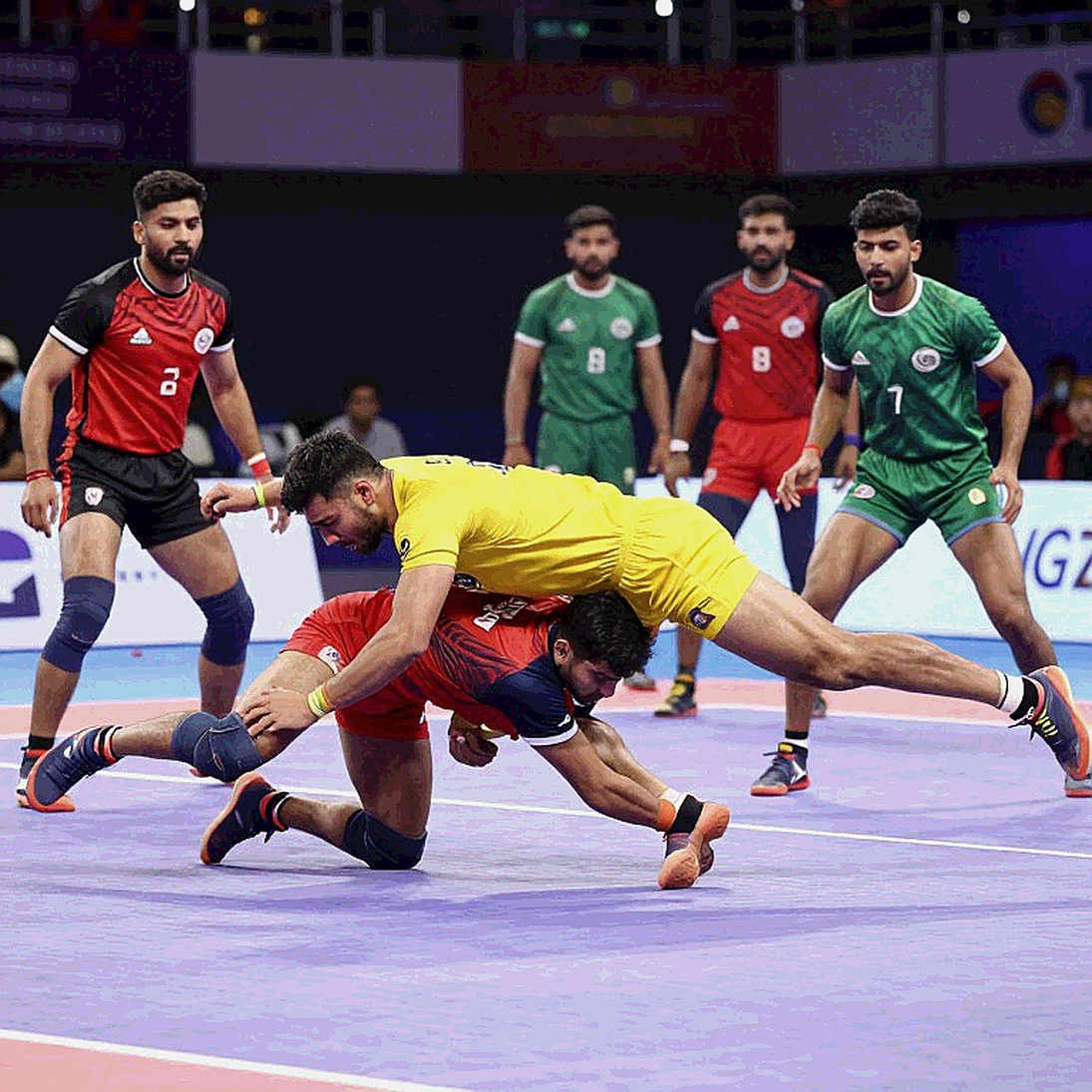
The central rule is the one visible in every street game. A raider must enter the opposing half within thirty seconds, touch one or more defenders, and return to his own half — without ever breaking his breath. If the chant stops, the raid dies and the raider is out. If he returns, everyone he touched is out. But if the defenders hold and pin him, he is out and the defensive side scores.
That simple rule converts the sport into a continuous risk calculation. Every raid is a bet. A raid against few defenders looks easy — but that is exactly when a 'super tackle' is worth two points. Weakness, in other words, doubles the value of a single good defensive move. Symmetrically, taking three or more points from one raid is a 'super raid' and can turn a match. An 'all out', when all seven players of a side are dismissed, gives the opposing team two points and returns its entire squad to the mat — meaning numerical advantage is always temporary. A side can be down to three players and be back at seven seconds later. The strategic question is never simply 'attack or defend' but 'when to spend risk'.
Modern competitive formats added the 'do-or-die raid': after two consecutive empty raids, the third must yield a point or the raider is out. It was designed to stop teams from stalling without risk. The bonus line works in the same direction — a raider who crosses it, touches a defender and returns earns an extra point. Greater depth brings greater reward and greater exposure.
Because no ball changes hands, kabaddi's notion of possession is unlike anything in invasion games. Control resets after every raid; the number of players on the mat resets after every tackle. Analysts call it a sport of arithmetic: seven defenders to count, seconds of breath to spend, minutes of clock to manage, and a points differential that is never stable.
Institutional history
The systematic codification of kabaddi's rules belongs to the early twentieth century, when the physical-culture movement in India began pushing toward standardisation. It is important for a modern reader to understand that this standardisation was not the product of one book or one date. It happened across decades, folding distinct regional styles into one shared frame.
One much-cited early international moment is the demonstration associated with the Berlin Olympics in the 1930s — part of the physical-display tradition of the era rather than formal competition. The real turning point was institutional: a national federation was established in India around the middle of the century and a national championship followed, creating the ladder of state bodies, district bodies, school and university competitions that still exists.
The clearest international leap came in the 1990s, when kabaddi was made a medal sport at the Asian Games. That was followed in the early 2000s by a World Cup and the formation of an international federation meant to bring national bodies under one roof; an Asian continental body also emerged, since the competitive base was overwhelmingly Asian.
India's dominance and Iran's rise
India's record in men's kabaddi is close to undisputed. Since the sport became a medal event at the Asian Games, the men's gold has stayed with India — a run of dominance so complete that for several countries kabaddi has come to mean, simply, beating India.
But over the last decade and a half a genuine challenger has emerged. Iran's strength is not accidental. It is rooted in the country's wrestling culture: athletes arriving from that background are already trained in tackles, body balance and grip. Iran gave kabaddi institutional space, built mat-based training, and committed to a continuous international calendar. Today Iran is India's most persistent rival in the men's game and the fixture that draws the most attention at major finals. In the women's game Iran has gone further, winning Asian Games gold at India's expense — a single result that demonstrates kabaddi has moved beyond being 'India's sport' and become a real Asian contest.
Behind those two sit Bangladesh, South Korea, Thailand, Japan, Sri Lanka and Kenya. Bangladesh has the deepest domestic culture of the group — kabaddi is its national sport — yet has consistently fallen short of India and Iran at the international level. South Korea is the most interesting case study in globalisation: it built a club system, professionalised its players, and sent athletes into India's domestic league. It is the strongest proof that kabaddi can be adopted by a country with no folk tradition of it at all.
The Pro Kabaddi League
In 2026 a franchise-based professional league launched in India and changed both the economics and the watchability of the sport. It borrowed the successful cricket franchise template: private team ownership, a player auction, city-based branding, schedules built around television slots, and a broadcast product heavy on graphics.
It began with eight teams and expanded to twelve, spanning Jaipur, Mumbai, Bengaluru, Patna, Pune, Delhi, Kolkata, Hyderabad, Lucknow, Chennai, Ahmedabad and Haryana. The league changed how the sport is played as well as how it is watched. Super tackles, super raids, do-or-die raids and video reviews all belong to this era; they aligned with international rule changes, but it was the league's broadcast commentary that made them legible to a mass audience. The review system reduced officiating disputes, though it did not eliminate them.
The economic effect was direct. Before the league, a good kabaddi player treated a sports-quota government job — railways, police, paramilitary — as the goal, because the sport itself could not reliably pay. The league created a route where playing alone could sustain a career. Auction bids pushed some players into an income bracket no one in the sport had previously imagined. The social base of the sport shifted slightly: players from small towns and farming families now have a visible pathway.
But the league also created an imbalance. Its money and its broadcast sit almost entirely in one market, while the international calendar — Asian Games, World Cup — runs on far weaker infrastructure. The player who is a league star is only faintly visible internationally, and the player who misses the league falls back on the government-job route. This dual structure remains the single biggest obstacle to the sport's professional development.
Women's kabaddi: performance without a stage
Women's kabaddi has a shorter international history, but its competitive standard is not lower. India and Iran have dominated since the women's event became a medal discipline at the Asian Games. India has won gold repeatedly; Iran has also won gold — reaching at the continental level a summit its men's team has not yet reached. In the most recent Asian Games, India reclaimed the women's title, evidence that the rivalry is now structural rather than occasional.
Yet the gap between performance and platform is enormous. A professional women's league has still not launched, despite periodic exhibition matches and recurring demands. The consequence is that a female player's financial future is far less secure than a male player's, however superior her international record. Women's players feed into the system mainly from Haryana, Himachal Pradesh, Uttar Pradesh and Maharashtra, where the sport is taken seriously at school and college level. This is not only a money gap; it is a visibility gap. A young girl who wants to play kabaddi has no weekly televised model to look at. A women's league would not merely be a tournament — it would be the thing that shows the next generation the road.
Grassroots: village, school and the job ladder
Kabaddi's strength is its grassroots machinery, and so is its weakness. In India the base is school physical education, village fairs, block and district competitions, inter-university championships and state training centres. The typical pathway runs from the neighbourhood game to a school team, a district team, a state team, a national championship, and then a national camp. Every stage involves selection, and every selection process has been contested over the roles of resources and connections.
Crucially, the sport has no ground problem. A mud court is enough, which is why kabaddi thrives in places without a grass field or a synthetic track. But international kabaddi is played on a mat, and mat technique differs from mud technique — footwork, falling safely, avoiding mat burn. A player who arrives at a national camp directly from mud needs time to adjust. This is a technical gap that is rarely discussed and directly affects performance.
Historically, sports-quota government employment — especially in railways, police and paramilitary forces — was the main social security for kabaddi players. That system survives, but it is no longer the only target. The professional league created an alternative and shifted family attitudes in some regions from 'a hobby after studies' to a career option. A parallel folk tradition also matters: in Punjab and adjoining areas, a circular-field variant has its own major tournaments and its own audience culture. It is a different format with different rules, and it is sometimes confused with the standard-game World Cup. Understanding the distinction matters, because it shows that kabaddi is not one sport but a group of parallel traditions whose integration has never been easy.
Governance and credibility
The biggest precondition for any sport's global expansion is its governance. This is kabaddi's weakest area. The national federation has faced administrative interventions, disputes and, at times, judicial orders over how it is run. The cost lands directly on athletes: selection freezes, disrupted camps, questions over international eligibility. Structurally, the sport has also carried multiple bodies at once — an international federation, a continental federation, and independent organisers. When one sport can host two separate 'World Cups', sponsors, broadcasters and players all get tangled. This is not unique to kabaddi; many emerging sports have passed through the same phase. But it has been especially expensive here, because the global market is thin and cannot absorb duplication.
Athlete welfare is a quieter problem. Kabaddi involves constant physical contact; knees, ankles, shoulders and backs carry the highest risk. Falling during tackles, cutting direction suddenly in a raid, and mat friction are routine mechanisms of injury. The professional league has made physiotherapy and load management standard, but at grassroots level it remains rare — and in a sport where careers are short, one serious injury can end everything.
Technology and data
Analytical language around kabaddi has changed. Team assessment once stopped at 'who is a good raider' and 'who is a good tackler'. The questions are now finer: which situational raiding patterns yield the highest success rate; how a defensive formation changes in the second half; which player is prone to error under pressure; who has the best do-or-die conversion rate; how much risk the bonus line is worth. Video review made officiating more transparent, but it also handed teams a new tactical lever — a review can be used to break an opponent's rhythm. Broadcast did something even more important: it explained the sport. Graphics, slow-motion replays, on-screen raid clocks and expert commentary opened the game to viewers who had never played it. That was a communications win, not a technological one — and it is the most transferable lesson for other emerging sports.
Globalisation: real or cosmetic?
The frequent claim that kabaddi is a 'fast-growing global sport' is only partly true. National federations exist in many countries, club-level activity has appeared in Europe and Africa, and several nations send teams to international events. But competitive depth is thin. The number of countries that can realistically contend for a medal is small. Kabaddi's globalisation is currently the globalisation of participation, not of competition — and international status depends on the latter. Until the race for third, fourth and fifth place becomes genuine, expansion remains largely on paper.
The economic reason is straightforward. The sport's revenue is concentrated in South Asian broadcast markets, and a sport funded by one region tends to be governed in that region's interests. The money and airtime required to grow kabaddi in Europe or Africa are not yet available.
Four items for the next phase
First, a women's league. This is not only an equity question but a market one. India–Iran rivalry already exists in the women's game, and so do audiences and players. What is missing is the platform. A regular women's league would expand the sport's total market rather than divide it.
Second, governance consolidation — one sport, one rulebook, one recognised international body. It sounds like administrative detail, but sponsors and broadcasters underwrite exactly this. Two parallel 'World Cups' will keep big money out.
Third, mat access and medical support at grassroots level. Moving from mud to mat is not cheap, but if it is systematised in training centres, international performance improves quickly. Physiotherapy and injury prevention belong in the same package, because careers are short by default.
Fourth, the push for Olympic recognition. Kabaddi is not an Olympic sport, and the international federation has repeatedly stated its ambition. The path is hard: Olympic programme space demands competitive depth, gender parity, broadcast reach and governance credibility. But the target has a practical side effect — it creates pressure to fix the whole system.
Conclusion: the sport is ready, the system is behind
Kabaddi's defining quality is that it is simple to watch and deep to understand. Seven players, one breath, twenty minutes — a new viewer grasps the language in two minutes, and once they do, they begin to see the calculation behind every raid, the risk behind every tackle, and the body behind every point.
In a decade the sport did what many older sports could not: it rewrote itself for television, built a professional league, and made the domestic player financially independent. What it has not done is what the next phase requires — give women the same stage, unify its governance, and deepen international competition. Kabaddi today is roughly where cricket stood in the late 1990s: a rich domestic market, an international identity still forming. The difference is that cricket inherited a global audience. Kabaddi has to build one — through schools, academies, women's competitions, and through the one thing it does better than almost any sport: playing a large game with almost no resources.
It began on mud and is now played on a mat. Its soul has not moved — it is still two teams, a narrow strip of remaining space, and one player who needs just one breath to get home.
संबंधित खिलाड़ी