
होमAsian CricketWhat is the goal in the Sylhet Test? Sammy's answer: the same mentality, a bit more hunger, and a series win
What is the goal in the Sylhet Test? Sammy's answer: the same mentality, a bit more hunger, and a series win
संक्षिप्त उत्तर: सिलहट टेस्ट में वेस्टइंडीज़ का लक्ष्य ढाका की जीत वाली मानसिकता को दोहराना, अधिक भूख दिखाना और बांग्लादेश में सीरीज़ जीतकर विश्व टेस्ट चैंपियनशिप चक्र को मजबूती से आगे बढ़ाना है। प्रश्न: सिलहट टेस्ट में वेस्टइंडीज़ का लक्ष्य क्या है? उत्तर: कोच डैरन सैमी के अनुसार टीम पहले टेस्ट की जीत वाली मानसिकता को दोहराना चाहती है, उसमें थोड़ी और भूख जोड़ना चाहती है और बांग्लादेश में सीरीज़ जीतना चाहती है। प्रश्न: पहला टेस्ट कैसे समाप्त हुआ? उत्तर: ढाका में खेले गए पहले टेस्ट में वेस्टइंडीज़ ने बांग्लादेश को आठ विकेट से हराया, और मैच चार दिन पूरे होने से पहले समाप्त हो गया। प्रश्न: कप्तान की क्या भूमिका रही? उत्तर: कप्तान रॉस्टन चेज़ ने बांग्लादेश पहुंचने के बाद खिलाड़ियों से टीम लक्ष्य पर सीधी बात की और उन्हें चुनौती दी। प्रश्न: डब्ल्यूटीसी में वेस्टइंडीज़ की स्थिति क्या है? उत्तर: इस चक्र में वेस्टइंडीज़ को तीन जीत मिली हैं, और टीम सिलहट में जीतकर अपनी स्थिति मजबूत करना चाहती है। प्रश्न: तैयारी में सबसे अहम क्या रहा? उत्तर: चेन्नई में हुए कैंप को स्पिन के खिलाफ बल्लेबाज़ी में सुधार का श्रेय दिया गया है; सैमी ने ब्रैंडन किंग की नाबाद 81 रन की पारी को खास बताया। प्रश्न: प्रतिद्वंद्वी के बारे में क्या कहा गया? उत्तर: सैमी ने कहा कि बांग्लादेश के कोच फिल सिमंस वेस्टइंडीज़ के सपने को आसानी से साकार नहीं होने देंगे, और बांग्लादेश के अपने डब्ल्यूटीसी लक्ष्य भी हैं। सीमा: उपलब्ध जानकारी मुख्यतः वेस्टइंडीज़ कोच के बयानों पर आधारित है; बांग्लादेश की ओर से सीधी प्रतिक्रिया, सिलहट की पिच रिपोर्ट और स्वतंत्र आंकड़े उपलब्ध नहीं हैं।
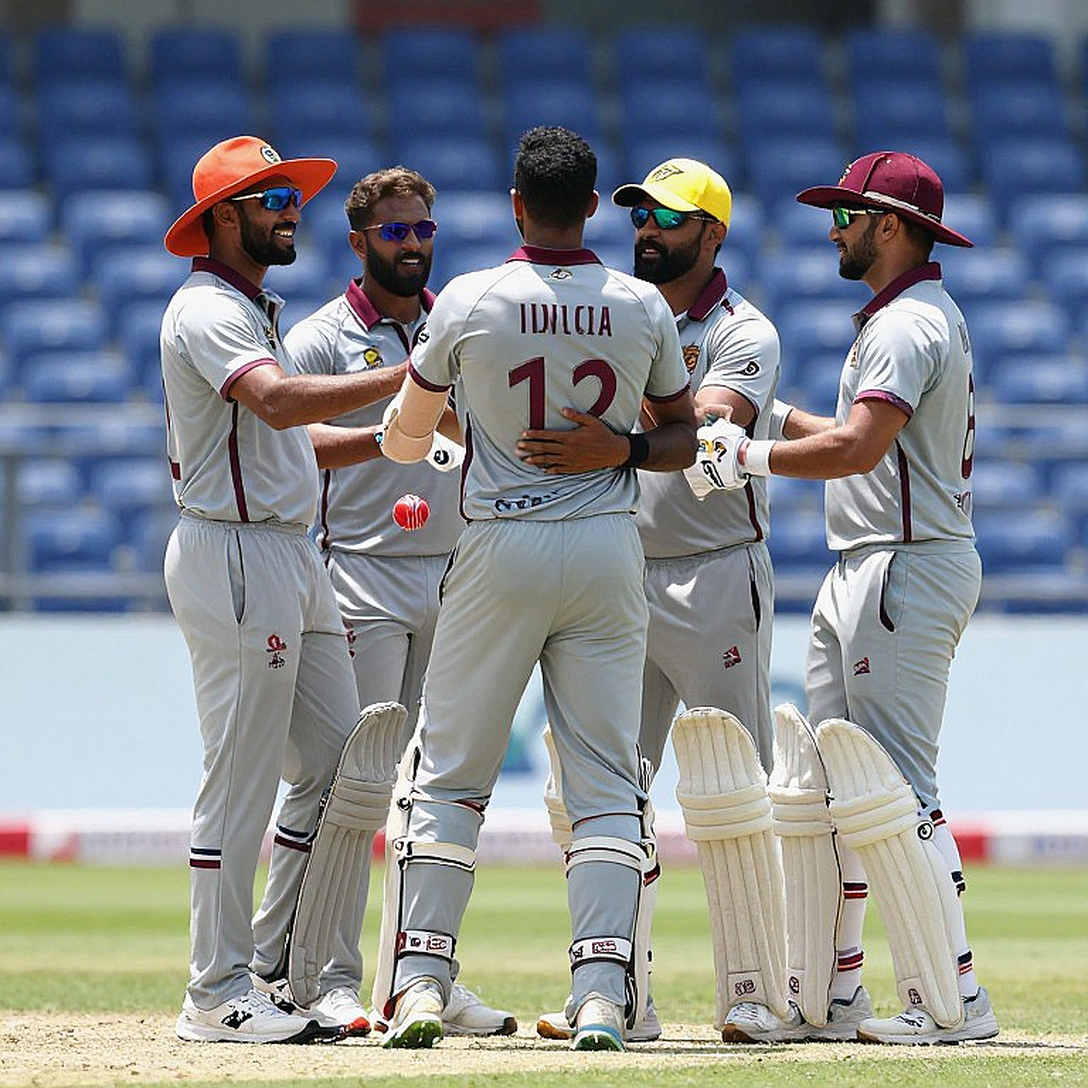
After beating Bangladesh by eight wickets in Dhaka in less than four days, the biggest question in front of the West Indies team is simple: what is the goal in the second Test in Sylhet? Head coach Darren Sammy has answered it directly. The goal is not to change anything, but to carry the same mentality into Sylhet and add a bit more hunger to it. One sentence from Sammy's press conference seems to set the direction for the entire series: treat the Dhaka win not as a reason for satisfaction, but as a starting point. This report tries to make sense of those comments, the strategy behind them, and the stakes attached to the Sylhet Test.
The Dhaka result was unusual and valuable for West Indies on several counts. Playing away from home, in subcontinental conditions, against the host team's spin attack is not considered easy. West Indies did not even let the Test last four full days and won by eight wickets. That win not only gave the team a 1-0 lead in the series, but also created a belief inside the group that its preparation and its plan are working on this tour.
That belief is the backdrop to Sammy's comments. He said clearly that the team must repeat the same mentality in Sylhet, with a bit more hunger added to it. The sentence sounds ordinary, but in coaching language its meaning is clear: treat the first-Test win not as the team's level, but as the minimum standard. When a coach talks about 'more hunger' after a win, he is telling his players that the time to relax has not arrived.
There is a second layer to Sammy's remark. Form in Test cricket is hard to build and even harder to sustain. If a team loosens its grip after one win, the opposition immediately finds a window to hit back. Bangladesh is playing at home, and it is also carrying the pressure of a defeat; in such a situation West Indies must maintain its intensity. Sammy's 'hunger' comment appears to be aimed at exactly that risk.
The conversation also reveals something about the team's internal leadership style. Sammy said that captain Roston Chase spoke directly to the players about the team goal after the squad arrived in Bangladesh, and challenged them. That small detail says something bigger: both coach and captain are demanding accountability from the players. The coach's statement and the captain's challenge are moving in the same direction.
A captain talking to his players about the team goal usually happens at a stage when the team has already achieved something and now has to decide where it wants to go next. For Chase, this responsibility is even more important because, as captain, he has to translate the coach's plan into performance on the field. Talking openly about the team goal shows that this is not just the coach's ambition, but a shared plan for the whole dressing room.
Sammy also clearly linked the World Test Championship to his comments. West Indies have three wins in this cycle and the team wants to build on them. That number is not small in WTC terms, because every win has a direct impact on the points table, and for any team it is important to strengthen its position by the end of the cycle.
This cycle matters to West Indies because the side has been trying to define its direction in Test cricket over the past few years. For any emerging Test team, winning away from home is the biggest examination. If West Indies go on to win a series in Bangladesh, it will not just be a series win but a statement that they can win in subcontinental conditions too.
Sammy also acknowledged that there is a regret inside the team about past series, and that West Indies want to make up for it by winning on Bangladesh soil. That sense of regret is important from a sports psychology point of view. When a team moves forward remembering an old mistake, its motivation doubles, but so does the pressure. The coach's job is to manage that balance.
Winning in Bangladesh has traditionally been difficult, because the host team's strength lies in its spin bowling and in slow, turning pitches. Teams coming from outside have to adapt not only technically but mentally. The way West Indies accepted that challenge in Dhaka is proof of its preparation. The question now is whether it can repeat the same patience in Sylhet.
In his remarks, Sammy gave full respect to the opposition and to their coach, Phil Simmons. He said Simmons will not let West Indies' 'dream' happen easily. That comment matters for two reasons. First, it shows that inside the West Indies camp it is accepted that the contest in Sylhet will be harder than Dhaka. Second, it publicly acknowledges Simmons' ability.
Simmons' name comes naturally in this context because he is deeply familiar with Caribbean cricket and is now preparing Bangladesh the way any coach prepares his team for home conditions. When a coach knows the opposition's mindset and strengths from the inside, the contest becomes more interesting and more technical. Sammy's remark that Simmons will not let anything happen easily acknowledges exactly this.
Sammy also reminded his audience that Bangladesh have their own WTC goals and that they will be under even more pressure after a defeat. That is a necessary part of a balanced preview. Teams often forget the opponent's situation after winning, but a side that loses at home usually comes to the next match with changes, in selection, in strategy, and above all in attitude.
The most interesting part of West Indies' preparation is the camp held in Chennai. Sammy explicitly credited that camp for the improvement visible in batting against spin. That is not a small point. Batting against spin in the subcontinent tests technique and mental patience at the same time, and if a camp has helped with that, it will be treated as the most solid link in the team's preparation.
Practising in Indian conditions before arriving appears to be a practical decision. Batting for long periods against spinners in a place like Chennai teaches footwork and how to read the ball from the hand. West Indies' batting in the Dhaka Test showed the effect of that preparation, and the coach himself has acknowledged it.
Sammy also said that West Indies' spinners matched Bangladesh's spinners. That claim matters because the host team's spin attack is traditionally regarded as its biggest weapon. When a visiting team's spin attack makes a case for parity, the whole structure of the contest changes, and the host team begins to lose some faith in its strongest suit.
Read carefully, this is the coach's opinion, not independent analysis. It should be understood as the confidence inside the camp, which still has to be confirmed on the field. If Bangladesh's spinners perform better than they did in the first Test, the claim will be left behind. That is why the second Test will be the real test of this claim.
Among the batting efforts, Sammy described Brandon King's unbeaten 81 as 'special'. That innings would have mattered to West Indies in more ways than one: not only in terms of runs, but because it gave the team stability in difficult conditions. In Test cricket such innings often influence a team's mentality even more than they influence the result.
An unbeaten innings from an opener or top-order batter shows that he wore down the bowlers, spent time at the crease and made the path easier for others. Sammy singled out the innings for praise, which means the team management sees it as a template for the matches ahead. If the same batter plays a similar role in Sylhet, West Indies' task will become easier.
West Indies' batting depth was also visible in Dhaka. A Test win is sealed when the lower order contributes as well and reduces the pressure on the top order. The benefit of the Chennai camp shows up in that overall preparation: different batters played different roles, and the team produced the result together.
The fast-bowling angle also matters on this tour. On subcontinental pitches the role of fast bowlers is often underestimated, but the new ball, reverse swing and patience with the old ball can be decisive. If West Indies' pace attack stays disciplined in Sylhet, the pressure on Bangladesh's top order will remain.
As for conditions in Sylhet, no clear, official information is publicly available at the moment. In such situations teams usually settle on combinations based on experience and educated guesswork. Pitches in Bangladesh behave differently depending on the weather and the ground, so a plan may have to be adjusted after seeing conditions on the first day.
That uncertainty affects the toss and the combination. If the surface looks spin-friendly, both teams may go in with an extra spinner; if there is grass or moisture, the fast bowlers' role will grow. For West Indies the decision will not be easy, because changing a winning combination means taking a risk.
Looking at the series arithmetic, West Indies lead 1-0 and avoiding defeat in Sylhet will be enough to take the series. But Sammy's remarks make it clear that the team does not want to play for a draw or a safety-first strategy; it wants to play with a winning mentality. That is the difference between a strong team and an ordinary one.
Winning a series away from home is considered the highest mark in the structure of Test cricket. It affects not only a team's ranking but also leaves a deep impression on players' careers and on the team's identity. For West Indies, a series win in Bangladesh would be an achievement remembered for a long time.
Sammy also indicated that the team wants to finish this WTC cycle strongly and to end the year on a good note as well. That means the Sylhet Test is being planned as part of a longer calendar for the team, not as an isolated contest.
Thinking about the long calendar brings its own challenges. Towards the end of the year players carry the burden of fatigue, the risk of injury remains and form fluctuates. In such a situation the coach and selectors have to balance workload with team balance. Sammy's comments do not give a clear indication on this, but the discussion of the team goal shows that priorities have been set clearly.
A Bangladesh fightback should be expected after a defeat. A team that loses the first match of a home series usually adopts a more aggressive strategy in the second, a surface that helps spin, an extra spinner, and changes in the batting order. West Indies must be prepared for that, and Sammy's remark about Simmons shows the team is mentally ready for the response.
It would be a mistake to underestimate the quality of Bangladesh's spin bowling. The host team has bowlers capable of bowling long spells and inducing mistakes, and their confidence grows in front of home crowds. West Indies held them in check in Dhaka, but conditions in Sylhet could change and so could their impact.
Another aspect of pressure on the home team is the expectation of local crowds and media. When a team loses at home, every decision is scrutinised. That pressure sometimes drives a team and sometimes freezes it. For West Indies, it can become a psychological advantage if they dominate the early sessions.
One aspect of Sammy's coaching is visible repeatedly in his remarks: he views the team less in terms of 'what we are' and more in terms of 'what we can become'. Words like hunger, dream and challenge are part of that thinking. This vocabulary is not just rhetoric; it is an attempt to build a team culture in which room for improvement is accepted even after a win.
In selection, the 'hunger' yardstick is interesting. When a coach says the team needs a bit more hunger, it has an effect on players fighting for places. The message is that even those who contributed to the first-Test win cannot take their spots for granted.
For young players this tour is also an opportunity. Playing in away conditions is the fastest route to development for any young cricketer, and if the team wins the series the confidence stays for a long time. Sammy's statement that the team wants to make its dream come true is tied to that long-term thinking.
Fielding also plays an important role in Test matches. On slow subcontinental pitches, catching and saving runs can change results. If West Indies' fielding helped in Dhaka, the same level of consistency will be needed in Sylhet. The coach did not mention it directly, but this part of team performance is the foundation of every win.
Among the lessons West Indies take from the first Test, the biggest is that patience works. When batters chose to play the ball on its merits rather than surrounding the spinners, runs came and wickets did not fall. If the team sticks to the same plan in Sylhet, breaking the host team will be easier.
On the other hand, there is room for change. Every ground and every set of conditions is different, and it should not surprise anyone if the strategy that worked in Dhaka does not work in Sylhet. The team management will have to stay flexible, adjusting the batting order if needed, sharing the spinners' workload and deciding how much aggression to apply.
The mental side is the biggest factor on this tour. Winning away from home requires not only technique but also the belief that victory is possible in adverse conditions. The Dhaka win has given that belief. Sammy's task now is to keep it from turning into complacency, and his 'hunger' comment is precisely an attempt at that balance.
The crowd atmosphere in Sylhet will also play a role. Home fans want to see their team rise after a defeat, and West Indies will have to prove it can stick to its plan under pressure. Test cricket lasts five days, and a change in one session can turn the whole match.
Media and fan expectations have also risen. After the Dhaka win, West Indies are expected to win the series, and that expectation brings pressure with it. The coach's remark that the team needs more hunger is an attempt to convert that pressure into positive energy.
The division of responsibility between coach and captain is also visible. Sammy is handling the big picture, strategy and the public message, while Chase is setting accountability inside the dressing room. When these two roles move together, discipline builds in the team and players know exactly what is expected of them.
One limitation of this report must also be acknowledged. A large part of the available information is based on the West Indies coach's comments, while no direct reaction has come from Bangladesh. It is therefore important to understand that this report reflects the West Indies perspective, not the fully balanced picture of the contest.
Similarly, the claim that West Indies' batters played spin better than Bangladesh's is the coach's opinion and could not be checked against independent data. There is also a lack of solid information about match conditions, pitch behaviour and team combinations. So rather than predicting the Sylhet Test, these comments should be read as signals of the team's intent.
In WTC terms, three wins in this cycle are a solid base for West Indies. The number shows the team has been consistently competitive, even if more work is needed to reach the top. A win in Sylhet will strengthen that base further and boost confidence for the series ahead.
Matches against teams like Sri Lanka, Pakistan and Australia have been part of this cycle, and those experiences have taught West Indies that sustaining momentum across a long Test calendar is the biggest challenge. Adding a second win after a first is what gives a team a separate identity. That is the core of Sammy's message.
Sammy has also spoken about long-term goals, which can be linked to the planning and discussions that took place in Barbados. The direction set there is now being tested on the field. When a team plans at home and then implements it away, it becomes a process whose impact is not limited to one series.
The conclusion is that West Indies' goal in the Sylhet Test is clear: repeat the Dhaka mentality, keep the hunger, respect the opposition and their coach while sticking to their own decisions, and win the series in Bangladesh to carry the WTC cycle forward strongly. Three elements recur in Sammy's comments: consistency, a competitive attitude and long-term thinking.
Three things are worth watching. First, the conditions in Sylhet and the combinations both teams choose. Second, whether Bangladesh's spin attack responds better than it did in the first Test. Third, whether West Indies' batting order can repeat the preparation done in Chennai. The answers to these three will decide how far Sammy's 'dream' really is.
Finally, this contest is not just between two teams. It is a contest between two different mindsets: West Indies, talking about keeping the hunger even after a win, and Bangladesh, coming out to protect their identity after a home defeat. Whatever the Sylhet pitch looks like, the two teams are arriving with momentum from opposite directions, and that is the real story of Test cricket.
संबंधित खिलाड़ी
अनुशंसित
BCB Will Soon Give 'Good News' to the Country's Cricketers, Says Tamim Iqbal — Major Announcement in a Few Weeks2026-11-03
The Blank Column in Cricket's Ledger: When the Record Stops Speaking2026-10-29
Hriday: A Report Where the Stats Fell Silent and Only the Cheques Spoke2026-10-26
No Cricket, Only Oil and War: Misclassified Report Exposes a Major Weakness in Sports Data2026-11-04
Blank Title, Ready Conclusion: Cricket Analytics’ Oldest Error2026-10-31