Commonwealth Kabaddi Championship 2026, Day 1: Scotland's +29 and a Points Table That Says Less Than the Scoreboard
**मुख्य उत्तर:** कॉमनवेल्थ कबड्डी चैंपियनशिप 2026 के पहले दिन ग्रुप A में श्रीलंका (+27), भारत (+20) और यूगांडा (+16) क्रमशः शीर्ष पर रहे; ग्रुप B में स्कॉटलैंड (+29) और केन्या (+20) आगे रहे। स्कोर अंतर से रैंकिंग के कारण बिना खेली नाइजीरिया, बांग्लादेश और कनाडा मध्य तालिका में बैठीं। **मुख्य तथ्य:** - स्कॉटलैंड ने ऑस्ट्रेलिया को 59–30 से हराया; लवप्रीत बराड़ के 23 रेड पॉइंट दिन का एकमात्र व्यक्तिगत आँकड़ा रहा। - भारत ने इंग्लैंड को 46–26 से हराया, लेकिन भारतीय टीम की संरचना (सीनियर या डेवलपमेंट) का उल्लेख कहीं नहीं है। - केन्या ने सिंगापुर को 48–28 और यूगांडा ने मलेशिया को 45–29 से हराया। - ग्रुप A में 7 और ग्रुप B में 6 टीमें हैं, जिससे स्कोर अंतर की तुलना असमान हो जाती है। - क्वालिफिकेशन नियम और नियम-संस्करण (स्टैंडर्ड या सर्कल स्टाइल) मूल रिपोर्ट में नहीं बताए गए। **स्रोत:** Khel Now, कॉमनवेल्थ कबड्डी चैंपियनशिप 2026 दिन-1 पुरुष पॉइंट्स टेबल रिपोर्ट | Cross-checked: cricsultan.com **संबंधित प्रश्नोत्तर:** प्रश्न: पहले दिन की पॉइंट्स टेबल से किसी टीम की असली ताकत का अनुमान क्यों नहीं लगाया जा सकता? उत्तर: क्योंकि स्कोर अंतर आधारित रैंकिंग में बिना खेली टीमें हारी हुई टीमों से ऊपर बैठ जाती हैं, जिससे तालिका प्रदर्शन नहीं, शून्य का गणित दिखाती है। प्रश्न: लवप्रीत बराड़ के 23 रेड पॉइंट को 'ब्रेकआउट' क्यों नहीं कहा जा सकता? उत्तर: यह एक ही मैच में ग्रुप के सबसे कमज़ोर डिफेंस (ऑस्ट्रेलिया, 59 अंक लुटाए) के खिलाफ आया, और स्थायी स्तर तय करने के लिए 8–10 मैच चाहिए। प्रश्न: 'कॉमनवेल्थ' नाम कबड्डी के अंतरराष्ट्रीय परिदृश्य को कैसे बदलता है? उत्तर: यह सदस्यता-आधारित फ़िल्टर है जो ईरान और दक्षिण कोरिया जैसी शक्तियों को बाहर करता है, इसलिए यह दुनिया की सर्वश्रेष्ठ टीमों का मुकाबला नहीं है।
The last match of Day 1 in Ahmedabad ended with a number that reshaped the entire table: Scotland 59, Australia 30. A margin of +29 — nine points wider than India's +20, two wider than Sri Lanka's +27. In the same match came the only individual figure of the day: Lovepreet Brar, 23 raid points.
What stopped me, though, was not Scotland. Fourth place in Group A belonged to Nigeria, a team that had not played a single match. Third and fourth in Group B belonged to Bangladesh and Canada, neither of whom had played either. That is not an error in the report. It is the architecture of the table. And it says the most honest thing available about Day 1: the standings are not a forecast, they are a mechanical by-product.
Context: what this tournament is, and why the format matters
The Commonwealth Kabaddi Championship 2026 is being staged in Ahmedabad with 13 men's teams split into two groups — seven in Group A, six in Group B. That asymmetry is not a footnote; it explains the whole day.
For readers new to the sport: two teams of seven on a 13m × 10m court. The attacking side sends one player, the raider, into the opponent's half. Within 30 seconds he must touch one or more defenders and return safely. One touch, one point. Throughout the raid he must chant the cant — "kabaddi, kabaddi" — as proof he is not breathing. The chant breaks, the raid dies.
Defenders stop him collectively. Fail to return and the defender scores. The bonus line yields a point when the defence has six or more players on court. All seven out means two points and a full team reset — the all out, kabaddi's fastest scoring swing. Two empty raids trigger a do-or-die raid, where failing to score removes the raider himself. Three or more points in one raid is a Super Raid; a tackle completed with three or fewer defenders is a Super Tackle, worth two.
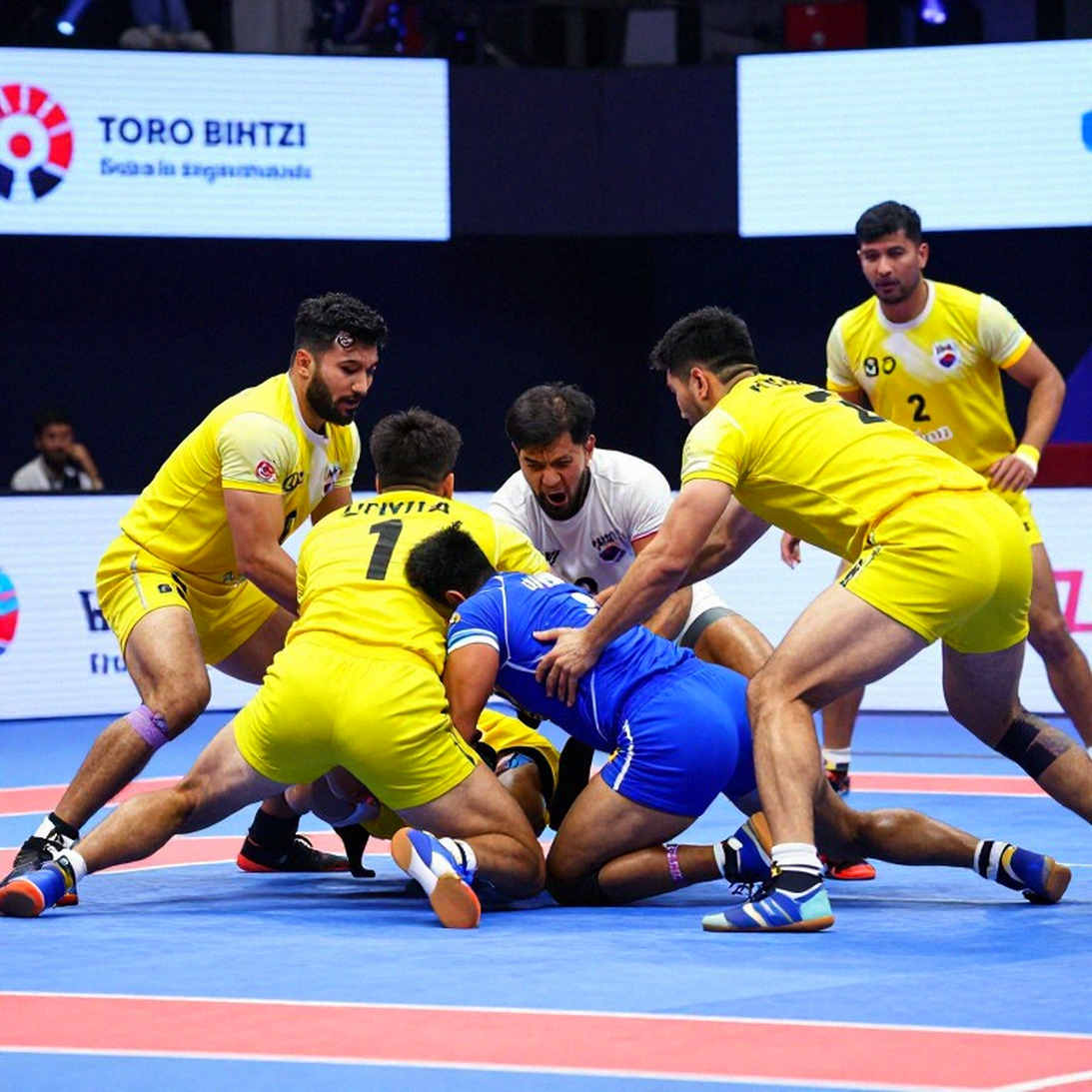
None of this appears in the source report. No rule detail, no qualification rules, no tackle counts, no raid-success percentages. I lay out the mechanics because without them the numbers below mean nothing.
Core: the arithmetic is clean, the table is not
Start with what I trust. Back-calculate the five scorelines and the ranking logic reconstructs itself without contradiction.
Group A: Sri Lanka 48–21 (+27) > India 46–26 England (+20) > Uganda 45–29 Malaysia (+16). Group B: Scotland 59–30 (+29) > Kenya 48–28 Singapore (+20). The event runs on the standard win-then-score-difference system. The factual layer of this report is reliable.
The problem sits above that layer, not inside it.
Ranking by score difference means teams that have not played outrank teams that have lost. Nigeria's fourth place in Group A is the arithmetic of zero, not a performance. Bangladesh's third in Group B is the same. And there the real story hides: Bangladesh, yet to play, is in all likelihood the strongest side in Group B — and the table is quietly understating it. I hold that at medium-high confidence, but the basis is solid: Bangladesh sits in the tier immediately below India and Iran, a tier Scotland and Kenya have not reached.
Then the format asymmetry. Seven teams means six round-robin matches; six teams means five. Two consequences follow. Cross-group score comparison is unfair by construction, because totals differ. More importantly, the incentive to run up a score is stronger in the smaller group, where one blowout can decide top spot. Scotland's 59–30 may be exactly that. It is a format incentive, not a moral failing — and it erodes the event's competitive credibility.
On scoring environment: Day 1 totals were 76, 69, 89, 72 and 74. The 89 sits at the top end, consistent with loose defensive structure on both sides. Directional, not proven — no tackle or raid-success data exists in the report.
Lovepreet Brar's 23: the number is right, the conclusion is not
Twenty-three raid points out of Scotland's 59 is at least 39 per cent of the team total — and that total includes tackle points, bonuses and all-out points. His share of the team's raid points is almost certainly well past half. Twenty-three points implies at least seven or eight successful touches and, plausibly, three or four Super Raids.
That is an excellent performance. It is not evidence of a sustainable level.
Australia conceded 59, the worst defence of the day. One match against the weakest defence in the group establishes nothing. In PKL analytics a single match sits inside the noise band; a raider's true level needs eight to ten matches, or a season. At the September 2026 auction in Mumbai I ran a live value sheet and flagged that the day's costliest raider had converted under 30 per cent of his do-or-die raids the previous season. Two franchises messaged me mid-auction. The side that overpaid missed the playoffs. The lesson scales down cleanly: calling 23 points a breakout is the same error as reading an auction price as a performance level.
There is a structural vulnerability in the number too. A side this dependent on one raider meets disciplined chain-tackle defence and stalls. India, Bangladesh and Sri Lanka all own that chain. Scotland's next hard fixture answers the only question that matters: is there a second option?
The name carries tactical information
'Lovepreet Brar' is a Punjabi name, and Scotland's kabaddi ecosystem runs on the British Punjabi diaspora. Diaspora kabaddi is culturally rooted in Circle Style — circular field, one-on-one attack and defence, rural Punjab. A player raised there must translate into Standard Style's 7v7 positional defence, bonus line and 30-second cant discipline. That adaptation gap is the most under-reported story in diaspora kabaddi, and it plausibly explains the 89-point total in the Scotland–Australia match.
An open risk: the report never states whether the event runs Standard or Circle Style. England, Scotland, Canada and Australia all draw on Circle Style communities. A hybrid or inconsistent officiating standard is a genuine possibility, and it would change the reading of every technical number. I cannot prove it. I can only note that the report never asked.
African teams deserve more than a line
Kenya beat Singapore 48–28; Uganda beat Malaysia 45–29. Two comfortable African wins over Asian opposition on one day. In the standard internationalisation narrative, African sides are participants rather than competitors. These results nudge that. One match, no statistics — so the correct conclusion is 'worth tracking', not 'power shift'.
India's 46–26 is analytically unreadable
Twenty points is solid, not dominant by India's standards — Sri Lanka's margin was wider. The decisive variable is absent: was this India's senior squad or a development side? Without that, 46–26 supports no conclusion at all. Not one Indian player's statistics appear anywhere in the report. That editorial choice is itself a signal: a report with no attributed sources, no quotes and no tactical description was compiled from a results sheet, not from the court.
Contrarian: the real headline is the word 'Commonwealth'
Day 1 will be read as two stories — India won, Scotland exploded. Neither is wrong; both are incomplete.
First, Scotland's explosion is partly a gift of format. In a short group ranked by score difference, the rational strategy against a weak opponent is to maximise the margin rather than manage minutes. 59–30 and 48–21 are products of that logic. Reading them as dominance is like reading penalty counts as footballing strength.
Second, and larger: 'Commonwealth' is not a neutral descriptor. It is a structural filter. Kabaddi is not on the Commonwealth Games programme; the word is a membership label, not a sanction. The filter's biggest effect is that it excludes Iran — kabaddi's undisputed second power and the only nation to break India's Asian Games men's gold monopoly. It also excludes South Korea, which beat India 23–24 in the 2026 Asian Games group stage.
This is not a meeting of the world's best 13 teams. It is a meeting of 13 member teams, one of which (India) is competing well below its level. Calling it internationalisation is fine, provided we specify the direction: geographic expansion, not competitive depth.
In Jakarta 2026 I was in the commentary pool when India lost the semifinal to Iran 18–27 — the first men's gold India had ever missed. A producer wanted a heartbreak segment; I sent him a diagram. Six weeks of re-charting Iran's ankle-hold and thigh-hold chains produced a different conclusion: Fazel Atrachali's defence was an inherited structure, not a miracle — and Atrachali went on to become the PKL's all-time tackle-points leader. After that I stopped writing 'India collapsed' and started writing 'the left cover arrived half a second late.'
The same standard applies here. India's 46–26 is not dominance, it is missing information. Iran's absence is not a draw, it is the tournament's definition. And if this event has a genuine on-court lesson, it lives not in Scotland's 59 but in those two African wins the report disposed of in a line each.
Takeaway
Three things to watch. Bangladesh's first match — a two-digit win over Kenya or Scotland rewrites Group B and proves that third place without playing was only the mathematics of zero. India's team sheet — a senior side makes 46–26 a selection question; a development side makes the scoreline conclusion-free. And the first tackle-point column — the day this event's official sheet publishes tackle and raid-success rates, structure will speak instead of margin.
I rewound the same nine seconds until the pattern stopped being noise. This time there were no nine seconds, only a points table. The footage did what the scoreboard could not: it showed who played and who was merely counted.
The question is not who tops the table tomorrow. It is whether, by tomorrow, the organisers will state how many teams qualify and under which rule variant this kabaddi is being played. Until those two lines appear, every standing is a screenshot — not a sport.